
If you are comparing Teeter vs. Innova inversion tables, you are probably not doing it just because you want another piece of exercise equipment.
Both Teeter and Innova can help you hang at an angle and use gravity to stretch your back. But they are built very differently.

Teeter is built more like a clinical spinal decompression table. Innova is built more like a comfortable home wellness table with padding, heat, massage, and a lower price.
Both can help you invert. Both can feel good. But they do not work the same way.
This guide compares Teeter and Innova inversion tables in simple terms so you can decide which one makes more sense for your back, your budget, and your home.
Teeter vs. Innova: Quick Answer
Choose Teeter if you want stronger spinal decompression, better safety validation, FDA registration, a longer warranty, and a table made mainly for back pain, sciatica, herniated discs, spinal stenosis, degenerative disc disease, and related spinal conditions.
Choose Innova if you want a cheaper inversion table, more padding, fixed angle control, and comfort features like heat, vibration, massage, or lumbar support.
- Teeter is better if your main goal is decompression.
- Innova is better if your main goal is comfort and budget-friendly stretching.
Sources for the comparison table: FDA 510(k) database, Teeter FitSpine product information, Innova product pages, and published inversion therapy research.
This post may contain affiliate links at no extra cost to you.
Is Teeter Better Than Innova for Back Pain?
Teeter is the better choice if your back pain feels compressed, nerve-related, or connected to a diagnosed spinal issue.
That includes problems like:
- Sciatica
- Herniated discs
- Degenerative disc disease
- Spinal stenosis
- Facet syndrome
- Chronic lower back pain
- Muscle spasms
- Tight spinal muscles
Teeter tables are registered with the FDA as Class I 510(k) medical devices for non-powered traction and paraspinal stretching.
That does not mean Teeter is a cure. It does not mean everyone with back pain should use one.
But it does mean Teeter is positioned more like a therapeutic decompression tool than a basic home fitness product.
A Newcastle University pilot randomized trial found that surgery was avoided in 76.9% of patients who used inversion therapy plus physiotherapy, compared with 22.2% of patients who received physiotherapy alone.
That is especially meaningful if you are worried your back problem may eventually lead to surgery.
If your main goal is spinal decompression, Teeter is the stronger choice in this comparison.
It makes the most sense if your back feels compressed, stuck, or nerve-related.
👉 Not sure which Teeter table to choose? See our full Teeter Fitspine Model Comparison
Is Innova Better for Comfort?
Yes, Innova is usually better if comfort is your top priority.
Many Innova models include thick padding, lumbar support, heat, vibration, or massage.
For example, the Innova ITM series includes heat and vibration massage. The ITM5000 includes Shiatsu massage rollers.
The ITX9900 includes an air-adjustable lumbar chamber.
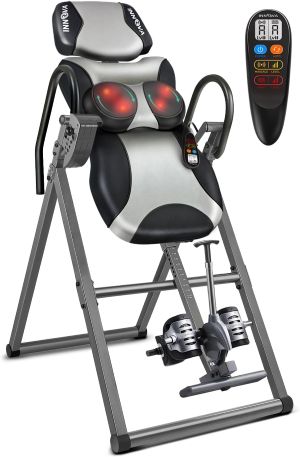
This can be appealing if your back pain feels more like tired, tight muscles after work.
Imagine coming home after standing all day, lying on a padded table, turning on heat and vibration, and letting your back relax for a few minutes.
That is where Innova makes sense.
But there is a tradeoff.
The same padding that feels comfortable can also reduce sliding and limit spinal elongation.
So Innova may feel better at first, while Teeter can stretch you better.
If your back feels tight, tired, or overworked after a long day, Innova may be the more comfortable choice. It is also the better budget option if you want to try inversion without spending as much.
Teeter vs. Innova Inversion Tables: Full Research
The Biggest Difference: Decompression vs. Cushioning

Inversion therapy works by using gravity to create traction through the spine.
When your body tilts backward, your upper body weight helps gently stretch the spine.
This may reduce pressure on the discs, relax tight back muscles, and create a decompression effect.
But the surface of the table matters a lot.
Think about lying on a smooth plastic slide compared with lying on a thick couch cushion.
On the smooth surface, your body can move and lengthen more easily.
On the soft cushion, your body sinks in and stays more fixed.
That is the basic difference between Teeter and Innova.
Teeter uses a firm, smooth plastic bed called FlexTech or ComforTrak.
This low-friction surface lets your torso slide more easily as you invert. That sliding helps create more axial spinal elongation.
In real life, this matters if you are trying to feel that “space opening up” sensation in your lower back after a long day of sitting.
Innova uses a thick, padded foam backrest.
It feels softer at first, which many people like. But it creates more friction. Your body sinks into the foam instead of sliding freely. That can reduce the decompression effect, especially at lower inversion angles.
- For someone who mainly wants to relax after work, that soft padding may feel great.
- For someone who is trying to reduce pressure from a stubborn disc issue, the extra friction may be a drawback.

At the same angle, Teeter keeps much more of the traction force because its bed has less friction.
This is important for people who do not want to go fully upside down.
For example, if you are nervous about inversion and only want to start at 20 to 30 degrees, Teeter may still give you a stronger decompression effect at that shallow angle.
With Innova, you may need a steeper angle to feel a similar stretch because the padded surface holds your body in place more.
Note about the traction score: To make the difference easier to understand, we used a simple traction-score model based on the idea that a smoother surface allows more body slide, while a padded foam surface creates more resistance.
The exact score is an estimate, not a manufacturer-tested traction measurement.
FDA Status and Clinical Use
This is one of the biggest reasons people choose Teeter.
Teeter tables are registered with the FDA as Class I 510(k) medical devices for non-powered traction and paraspinal stretching.
Teeter is cleared for:
Back pain, sciatica, herniated discs, muscle tension, muscle spasms, degenerative joint disease, spinal curvature due to tight muscles, degenerative disc disease, spinal stenosis, and facet syndrome.
Source: Teeter’s FDA-related product information lists these indications.
That does not mean Teeter is a miracle cure. It does not mean every person with back pain should use one.
But it does mean Teeter is positioned as more than a general fitness product.
That matters if you are worried your back problem may eventually lead to surgery.
In a Newcastle University study, many patients who were already waiting for lumbar disc surgery were able to avoid the operation after adding inversion therapy to their physiotherapy routine.
Innova tables are not positioned the same way.
They are consumer wellness and home fitness products. They may help with general tightness and temporary back discomfort, but we could not verify an independent UL 1647 listing for Innova from the official Innova pages reviewed.
So if your back pain is mild, occasional, and mostly muscular, Innova may be enough.
But if your pain is connected to a diagnosed spinal condition, Teeter is the more serious option.
Safety and Frame Strength – Which Brand Feels More Reliable?

When you use an inversion table, you are not just sitting on it.
You are trusting it while your body is tilted backward, sometimes nearly upside down.
That makes safety more important than it looks in the product photos.
Teeter uses heat-treated carbon steel.
This makes the frame 73% stronger than standard cold-rolled steel.
Teeter also uses continuous-seam robotic MIG welding and auto-locking hinges. These are meant to improve frame strength and reduce the risk of collapse or bed separation.
Innova uses heavy-duty cold-rolled steel. The frame is sturdy for regular home use, but it is not described as heat-treated.
Teeter is the stronger choice if safety certification is one of your top priorities.
If you plan to use your inversion table often, the Teeter inversion table’s safety testing and 5-year warranty make it the stronger long-term choice.
For example, using an inversion table once a week is very different from using it every morning before work and every evening after sitting all day.
Daily use creates repeated stress on the frame, hinges, welds, and ankle system.
Safety note: Teeter publicly lists FDA registration and UL safety certification for its FitSpine tables. We could not verify an independent UL 1647 listing from the official Innova pages reviewed; Innova does state that its products undergo safety and compliance testing for quality assurance.
Angle Control: Free Movement vs. Fixed Stops
Teeter and Innova also control inversion angles differently.
Teeter uses a dynamic balance system.
Once the table is adjusted to your height and weight, you control movement with your arms.
Raising your arms rotates the table back. Bringing your arms down helps rotate it upright.
Teeter uses an EZ-Angle tether strap to limit the maximum angle. This gives you more control over the angle.
This can feel smooth and natural once you get used to it.
But for a nervous beginner, it may also feel a little intimidating at first.
Innova uses a pin selector system.
You choose the angle before getting on the table, and the steel pin acts as a hard stop.
This makes Innova feel more controlled for beginners. You know the table will stop at a fixed angle, such as 15, 30, 45, 60, 85, or 90 degrees, depending on the model.
If you are the kind of person who thinks, “I do not want this thing to flip too far,” Innova’s fixed pin system can feel reassuring.
Ankle Comfort

Ankle comfort can decide whether you actually use the table or leave it folded in the corner.
When you invert, your ankles carry a lot of the load.
If the ankle holders pinch, dig in, or feel unstable, you will not want to stay inverted long enough to get the benefit.
Teeter uses Ergo-Embrace ankle cups.
These wrap around the ankles and are designed to spread pressure across the heel and ankle instead of pinching the Achilles tendon.
Premium Teeter models also have longer locking handles, which help people secure their ankles without bending too far forward.
That matters if bending down is already painful.
For example, someone with a lower back spasm may struggle just to reach their shoes. A longer ankle lock handle can make setup feel less stressful.
Innova uses the VCCTech reversible ankle system.
This includes U-shaped holders and foam rollers. The system can be reversed, so you can choose the setup that feels better with shoes, boots, or larger feet.
Premium Innova models also include longer handles for easier ankle locking.
So Teeter has the more shaped, supportive ankle cup design. Innova gives you more adjustability in how the ankle holders are positioned.
Comfort Features
This is where Innova becomes more appealing.
Many Innova models include thick padding, lumbar support, heat, vibration, or massage.
For example, the ITM series includes heat and vibration massage. The ITM5000 includes Shiatsu massage rollers. The ITX9900 includes an air-adjustable lumbar chamber.
This can sound good if your back pain feels more like tight, tired muscles than sharp nerve pain.
Teeter is less focused on padding and more focused on movement and decompression.
It does offer an optional Better Back Comfort Cushion, but the main design is still low-friction.
Teeter may not feel as cozy at first. But that firmer surface is part of the reason it can create a stronger decompression effect.
One problem with Innova’s heat and vibration is that the vibration may feel too loud for some people.
Heat may also take time to pass through thick clothing, which matters if your inversion session is only 5 to 10 minutes.
So Innova has more comfort features, but they may not always feel as relaxing or effective as expected during short sessions.
Assembly and Storage

This is the part many people do not think about until the box arrives.
Teeter is easier to assemble.
Teeter tables arrive about 80% to 85% pre-assembled and usually take 13 to 30 minutes to put together.
Teeter also offers the BILT app for 3D voice-guided assembly and the Teeter Move app for guided routines.
That matters if you hate unclear instructions or do not want to spend your evening sorting bolts and frame parts.
Innova takes longer.
Because many models have more frame parts, padding, headrests, and sometimes wiring for heat and massage, assembly can take about 45 to 90 minutes.
Storage is another real-life issue.
A table that is technically “foldable” is not always easy to live with.
Teeter stores flatter because the backrest is thin and unpadded.
Innova folds, but the thick foam and headrest can make it bulkier.
If you have a home gym or spare room, this may not matter.
But if you live in an apartment or need to store the table behind a door, in a closet, or against a wall, Teeter is easier to manage.
Price, Warranty, and FSA/HSA
Price is where Innova has a clear advantage.
Teeter costs more upfront. Prices range from about $259 for the EP-560 to over $599 for the FitSpine LX9.
But Teeter includes a 5-year full warranty. It covers the frame, accessories, fabrics, parts, labor, and domestic transportation.
Teeter is also FSA/HSA eligible because of its medical device status.
That can make the real cost lower if you are using pre-tax health funds.
Innova is cheaper.
Prices usually range from about $99 to $250. This makes it easier to try inversion therapy without spending as much.
For someone who is not sure whether inversion will become part of their routine, that lower price is a big deal.
But Innova has a shorter 1-year limited warranty. Some wear items, like vinyl upholstery, may not be covered. You may also need to pay return shipping for a warranty claim.
Innova is not automatically FSA/HSA eligible. You may need a Letter of Medical Necessity from a licensed physician.
So the price question is not just “Which one is cheaper?”
The better question is:
Do you want to spend less now, or invest more in a table that is built for longer-term use and medical-style decompression?
Safety Warning: Who Should Not Use an Inversion Table
Inversion therapy is not safe for everyone.
Do not use an inversion table without medical approval if you have hypertension, heart disease, recent stroke, TIA, cerebral sclerosis, glaucoma, detached retina, conjunctivitis, spinal fracture, spondylolisthesis, osteoporosis, unhealed fractures, swollen joints, recent surgery, knee instability, pregnancy, hernia, severe obesity, or acid reflux.
Being inverted can increase blood pressure, intraocular pressure, and abdominal pressure. It can also place tensile load on joints, bones, and healing tissues.
This is not something to ignore.
If you already have a medical condition, talk to your doctor before using either table.
Medical safety note: Teeter’s contraindications guidance warns that inversion may be unsafe for people with certain cardiovascular, eye, bone, joint, digestive, pregnancy-related, obesity-related, or recent-surgery concerns. Always ask your doctor before using an inversion table if you have a medical condition.
FAQ
Which inversion table is better for sciatica, Teeter or Innova?
Teeter is the better choice for sciatica if your goal is stronger spinal decompression. Teeter’s low-friction bed allows the body to slide more freely during inversion, which may create better spinal elongation than a padded foam table.
Which inversion table is more comfortable?
Innova is usually more comfortable at first because it has a thick padded backrest and some models include heat, vibration, massage, or lumbar support. Teeter feels firmer, but that firm low-friction surface is part of what helps create stronger decompression.
Which inversion table is safer?
Based on the sources reviewed, Teeter has the stronger documented safety profile because it publicly lists FDA registration and UL safety certification.
Innova is described as sturdy for home use and says its products undergo safety and compliance testing, but we could not verify an independent UL 1647 listing from the official Innova pages reviewed.
Is Teeter worth the higher price?
Teeter is worth the higher price if you plan to use your inversion table often, want stronger decompression, need better safety validation, or want a 5-year warranty. It may also be more affordable than it looks if you can use FSA or HSA funds.
Is Innova better for beginners?
Innova may feel better for nervous beginners because it uses a fixed pin selector system. You choose the angle before getting on the table, and the pin acts as a hard stop. Teeter offers smoother movement and more micro-control, but some beginners may prefer Innova’s fixed-angle system.
Which is better for small spaces, Teeter or Innova?
Teeter is usually better for small spaces because its thin, unpadded bed allows it to fold flatter. Innova tables fold too, but the thick padding and headrest can make them bulkier when stored.
Final Verdict: Teeter vs. Innova
Teeter is the better choice if your main goal is spinal decompression, clinical-grade quality, safety validation, smoother traction, long-term durability, and FSA/HSA use.
It makes the most sense for people with more serious back problems, such as sciatica, herniated discs, spinal stenosis, degenerative disc disease, or chronic back pain.
It is also a better fit if you know you will use the table often and want something built for long-term confidence.
Innova is the better choice if you want a budget-friendly inversion table with more comfort features.
It makes the most sense for people with mild back tightness, general muscle fatigue, posture-related discomfort, or beginner anxiety about inversion.
It is also a good choice if you want padding, heat, vibration, massage, or a fixed-angle stop that feels less intimidating.
The simplest way to decide is this:
If your back feels compressed, stuck, or nerve-related, and you want the best chance at real decompression, choose Teeter.
If your back feels tight, tired, overworked, or achy, and you want an affordable way to stretch and relax, choose Innova.
Both brands can be useful.
But they are built for different people.
To your health and happiness,
The Back Pain Relief Products Team
Still not sure either brand is the right fit?
Browse Our Inversion Table Picks on Amazon to compare the other models we recommend.
Studies
- Inversion therapy in patients with pure single level lumbar discogenic disease: a pilot randomized trial
- Lumbar disc disease: the effect of inversion on clinical symptoms and a comparison of the rate of surgery after inversion therapy with the rate of surgery in neurosurgery controls

