

Inversion tables can be a very effective at-home option for some types of back pain, especially if you want temporary decompression and regular daily stretching without leaving the house.
Teeter is still one of the best-known inversion table brands, and for good reason:
The FitSpine line is safer, more refined, and more comfortable than most cheap inversion tables.
But the X1, X3, and LX9 are not the same.
In this guide, we’ll show you the real differences, who each model is best for, and which one is actually worth your money.
In a hurry?
See the 3 models compared in the table below, or jump to our detailed Teeter reviews below.
- Choose the Teeter X1 if you want the cheapest FitSpine model and do not mind the simpler ankle closure.
- Choose the Teeter X3 if you want the best overall value and easier entry, exit, and traction options.
- Choose the Teeter LX9 if comfort, easier boarding, and senior-friendly design matter most.
This post may contain affiliate links, at no extra cost to you.
👉 If you’re still figuring out whether inversion therapy is right for your specific type of back pain, see our full guide on inversion tables for back pain.
Is Teeter Better Than Other Inversion Tables?
First, we wanted to know:
What’s the difference between Teeter and other inversion tables?
Here’s the answer in three words:
Safety and comfort.
Safety is a major concern when choosing an inversion table.
Just imagine the type of injuries you can get from using an unsafe inversion table or a cheap, second-hand one.
Teeter stands out mainly for safety, comfort, and polish.
The current FitSpine models are UL safety-certified, listed by Teeter as FDA-registered Class 1 medical devices, and built around higher-end features like FlexTech backrests, precision balancing, and better ankle support than most budget tables.
Teeter uses specialized features including heat-treated steel, auto-locking hinges, and a special squeak-free roller bearing.
Last but not least:
Teeter offers a free Teeter Move app with videos and classes for guided stretching and workouts, and all models are covered by a five-year warranty.
How Much Do Teeter Inversion Tables Cost?
At the time of writing, Teeter’s FitSpine lineup is priced at about $349 for the X1, $399 for the X3, and $499 for the LX9 on Teeter’s official site.
All three models also include a 5-year warranty, and Teeter currently gives 90-day returns when you buy direct
The price depends mainly on extra features that contribute to the comfort level of the user while inverting.
Otherwise, all Teeter models support the same weight (300 pounds) and have the same sturdy and durable design.
Teeter FitSpine Inversion Tables – Which Model is Best?
The FitSpine is a relatively new series and replaces the older models (EP-560/EP-960, etc.) with upgraded features.
Here’s our detailed comparison:
1. Teeter FitSpine X1 Review
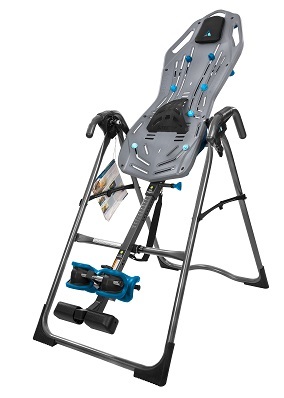
- Best for: people who want Teeter’s core safety and decompression features without paying for easier entry extras
- Skip this if: bending down or working the ankle lock is already hard for you
- 👉 Ankle system – T-Pin ankle closure (requires bending down)
The X1 is the cheapest real entry into the FitSpine line, but it is not stripped down.
You still get the FlexTech backrest, 8-point floating suspension, Lumbar Bridge, Acupressure Nodes, and Teeter’s secure Ergo-Embrace ankle supports.
The main compromise is the simpler T-Pin ankle closure and fewer stretching add-ons than the X3 or LX9.
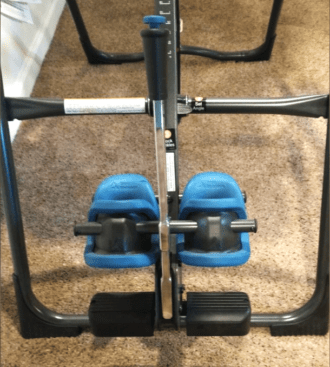
The adjustable tether allows you to pre-decide your maximum angle of inversion. You can also choose to remove the tether for full inversion at 90 degrees.
The stretch-max handles are shorter than the other X series models, but still give you something to grip.
What we especially like about the Teeter X series is the acupressure nodes, which provide trigger-point release while you invert, and the lumbar decompression bridge supports and focuses spinal traction on the lower back.
Teeter X1 Pros
- All-steel frame and 8-point suspension bed – a durable and comfortable inversion table
- UL-certified and FDA-registered
- Very comfortable ankle lock – won’t hurt your feet
- Precision balancing design allows for rotating and oscillating the table
- 5-year warranty and 90-day Try Teeter program
Cons
- Somewhat heavy and not so easy to move around (but this keeps it sturdy)
- Shorter handle
✅ Available on Amazon ($329)
- Height Capacity – 4 ft 8 in. – 6 ft 6 in
- Weight Capacity – 300 lbs.
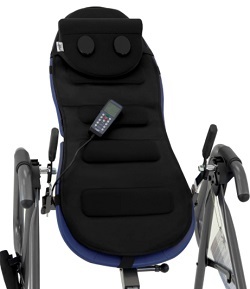
This programmable (with remote) cushion boosts your blood circulation with a gentle vibration massage and light heat technology in your entire back and neck!
2. Teeter FitSpine X3 Review
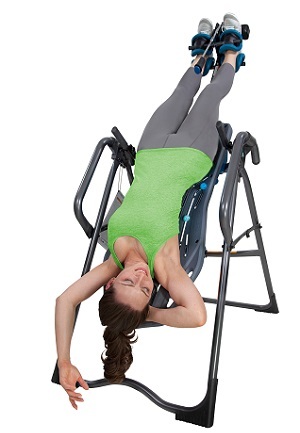
- Best for: most people, especially if you want easier ankle locking and better stretch control
- Skip this if: you want the lowest price possible and do not care about easier entry or premium extras
- 👉 Ankle system – Deluxe EZ-Reach ankle lock system (long handle, no bending)
The X3 is the sweet spot in the FitSpine range.
It keeps the same core frame and core decompression features as the X1, but adds the Deluxe EZ-Reach ankle lock system, Stretch Max handles, EZ-Stretch traction handles, and EZ-Angle tether with 20, 40, and 60 degree markers.
For most people, this is the model where Teeter starts feeling noticeably easier and more premium to use.
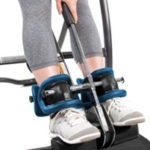
The X3 has upgraded longer handles that allow for more stretching options, and traction handles that allow you to add traction at any angle of inversion, for better spinal decompression.
Like all 3 models, this one also supports users up to 300 lbs and 6’6 inches in height and has those circulation-boosting acupressure nodes.

Teeter X3 Pros
- EZ-Reach Ankle System – The ankle support is designed just like hanging from Gravity boots
- EZ-Stretch Traction Handles
- EZ-Angle tether with 20, 40, and 60-degree quick-set angle markers
- Durable heat-treated 11-gauge steel frame
- 8-point suspension bed moves with you
- Easy to assemble
Cons
- Some users say that the grab handles are not so comfortable, which makes it hard to get out of the table without using your ab muscles
✅ Available on Amazon ($379-$449)
3. Teeter FitSpine LX9 Review
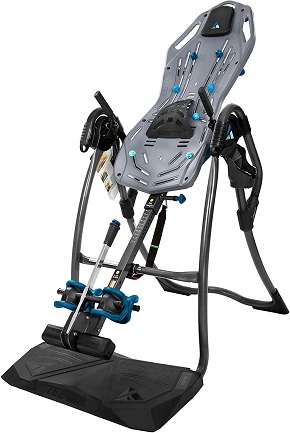
- Best for: older people, taller or less mobile people, and anyone who wants the easiest boarding experience
- Skip this if: you just want spinal decompression and do not need the easiest entry/exit design
- 👉 Ankle system – Deluxe EZ-Reach ankle system (same as X3, premium feel)
The LX9 is not better because it inverts you more.
It is better because it is easier to get on, easier to get off, and more comfortable to live with.
You get the same premium X3-style ankle and handle upgrades, then add the LX ergonomic arched frame, raised boarding platform, and storage caddy.
That is why this model makes the most sense for seniors or anyone who wants the smoothest everyday user experience.
There’s also a storage caddy on the side that you can use to store a phone, water bottle, or just the contents of your pocket while you invert.
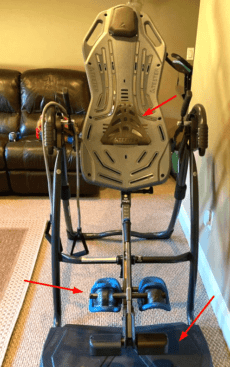
The Teeter FitSpine LX9 is the winner in terms of comfort, ease of use, and safety.
Teeter LX9 Pros
- Most luxurious model of the FitSpine series
- Most helpful features for safety and comfort
- Easy to assemble and use
Cons
- More expensive than the other models
✅ Available on Amazon.($499)
Teeter FitSpine vs. Teeter EP-560
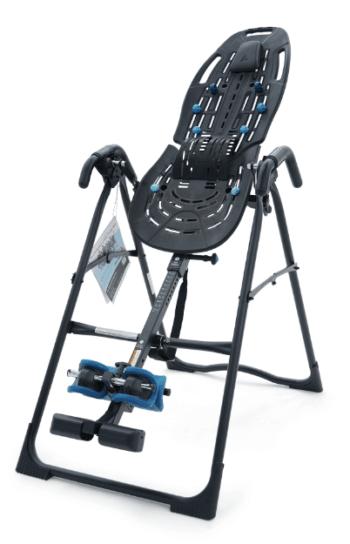
The EP-560 is still a cheaper Teeter option, but the FitSpine line is the more modern experience.
The big upgrade is the FlexTech backrest and the newer feature package.
If your budget is tight, the EP-560 may still work.
But if you want the newer Teeter platform and better comfort features, the X1 is the cleaner long-term buy.
✅ Available on Amazon ($299)
How to Use the Teeter Inversion Tables for Back Pain
It’s actually very easy to use Teeter’s new models. Here’s what you do:
Start at a shallow angle first, usually around 20 to 40 degrees, and give your body time to adjust.
Most people do not need full inversion to feel decompression.
Short sessions are usually the smart place to start, especially if your ankles are sensitive or you are new to inversion.
The goal is not to hang upside down forever – It is to find a comfortable angle you can use consistently.
Teeter Inversion Table Alternatives

If the idea of hanging upside down makes you nervous, this is the point where you should compare inversion tables with posture pumps, decompression belts, and lumbar traction devices.
Teeter is great for the right person, but it is not the only spinal decompression option.
While Teeter is the most trusted inversion table brand, there are a few lower-cost alternatives that can be just as effective, safe, and popular. See the best inversion tables under $200.
Where Are The Teeter Inversion Tables Made?
According to the Teeter official LinkedIn page, Teeter Inversion Tables have been made in factories in Thailand, Taiwan, and China for over 30 years.
Teeter manages all product design and management with their 50-person team.
The Teeter headquarters are located in the Pacific Northwest, in Bonney Lake, WA, south of Seattle.
The owner is Roger Teeter, a graduate engineer at the University of Wisconsin.
Do Teeter Inversion Tables Work For Everyone?
No. Teeter inversion tables work very well for some people, especially people who enjoy traction and spinal decompression, but they are not for everyone.
Some people get excellent short-term relief and keep using them for years.
Others find the relief more temporary, or simply do not enjoy inversion enough to stick with it.
👉 If you want something less intense than hanging upside down, here are the best spinal decompression devices you can use safely at home.
Do Chiropractors Recommend Teeter Inversion Tables?
Some chiropractors and rehab professionals do recommend inversion therapy for the right person, but it is not universally appropriate.
That is why it makes sense to check with your doctor first if you have high blood pressure, glaucoma, heart issues, osteoporosis, or any condition that might make inversion risky.
Which Teeter Model Should I Choose?
- Buy the X1 if your main goal is getting Teeter quality at the lowest price.
- Buy the X3 if you want the best balance of price, comfort, and upgraded features.
- Buy the LX9 if you care most about easier boarding, easier exit, and the most comfortable overall user experience.
Through our research, all the models feel solid, whether you are just at an angle or if you go with the full inversion.
Is the Teeter Inversion Table Easy to Assemble?
Assembly is easier than many people expect.
Teeter now supports setup with the BILT 3D Assembly App, printed instructions, and its own Teeter Move app for guided use after setup.
The parts are still fairly heavy, so unpacking is easier with help.
Conclusion
The best Teeter inversion table is not the most expensive one.
It is the one you will actually feel comfortable using several times a week.
For most people, that is the Teeter X3, because it gives you the biggest jump in comfort and ease without the full LX9 price.
The X1 is still a very strong buy if you want Teeter quality for less, while the LX9 is the best choice for buyers who want the easiest entry, exit, and overall experience.
What’s your experience with inversion for back pain? Share with us in the comments below.
To your health and happiness,
The Back-Pain-Relief-Products Team
How long should you hang upside down. Can hanging for an hour actually damage you ankles or feet ?
When using an inversion table, it’s recommended to hang up for 20 minutes max. It’s not supposed to damage your ankles or feet, the tables are carefully designed to feel comfortable. There’s no need to use it for an hour, you’ll get the same benefits and effect with 15 minutes of daily use.
I bought my first inversion table about 20 years ago. It was a hang-up. Very durable, and redoes the trick. Unfortunately, it was lost in a moving project. I am now saving for another one. I have suffered back pain and migraines for years, this was my medicine.
Such relief from pain and so easy. out of 5 stars had struggles with almost constant sciatica due to degenerative disk disease. When the pain became severe, I would have an epidural injection and return to my baseline, which wasn’t very good. Working full-time as an RN, I was willing to try almost anything. Having seen the Teeter Hangup, I researched the theory behind the anti gravity effect this product provided and decided to give it a try. I am so glad I did! I started out slow with the length of time I would hang and felt almost immediate relief. This product sits in my living room and I use it a couple of times a day for up to five minutes each time. I have no leg pain and haven’t felt this pain-free in years. It was easy to assemble and is built very sturdy and strong. Although at first, I was a little nervous about its ability, I now have complete faith and am so glad I gave this product a try. I strongly recommend this product for anyone with a similar condition. Teeter Hang Ups EP-550 Inversion Therapy Table
Thanks Joanathan, for sharing your experience with us…very helpful!